
Selecting the right commercial flooring installation NYC provider is often the difference between a floor that lasts a decade and one that fails before your first lease renewal. You already know that managing a facility in Manhattan or Brooklyn means balancing extreme wear and tear with strict building codes, complex COI requirements, and the constant fear of hidden subfloor costs. It's a logistical hurdle that many businesses struggle to clear without facing significant operational downtime.
You deserve a flooring solution that stands up to thousands of daily footsteps while meeting every local regulation. We'll show you how to choose the most durable materials, like high-performance LVT or resilient vinyl, while navigating the complexities of NYC building approvals. You will learn how a single-partner approach to preparation, installation, and post-project cleanup protects your investment and keeps your business running. This guide breaks down the essential steps to securing a high-traffic floor that remains functional and professional for 10 years or more.
Key Takeaways
- Identify the specific wear layers and PSI ratings required to withstand NYC's unique combination of 24/7 foot traffic and abrasive sidewalk debris.
- Navigate building logistics for commercial flooring installation NYC by securing the correct Certificates of Insurance and coordinating with local noise ordinances.
- Evaluate the performance differences between Luxury Vinyl Tile for high-traffic retail spaces and carpet tiles for professional acoustic management.
- Streamline your facility update with an integrated approach that covers everything from initial furniture removal to the final post-construction deep clean.
The Demands of NYC Commercial Flooring: Why Durability Matters
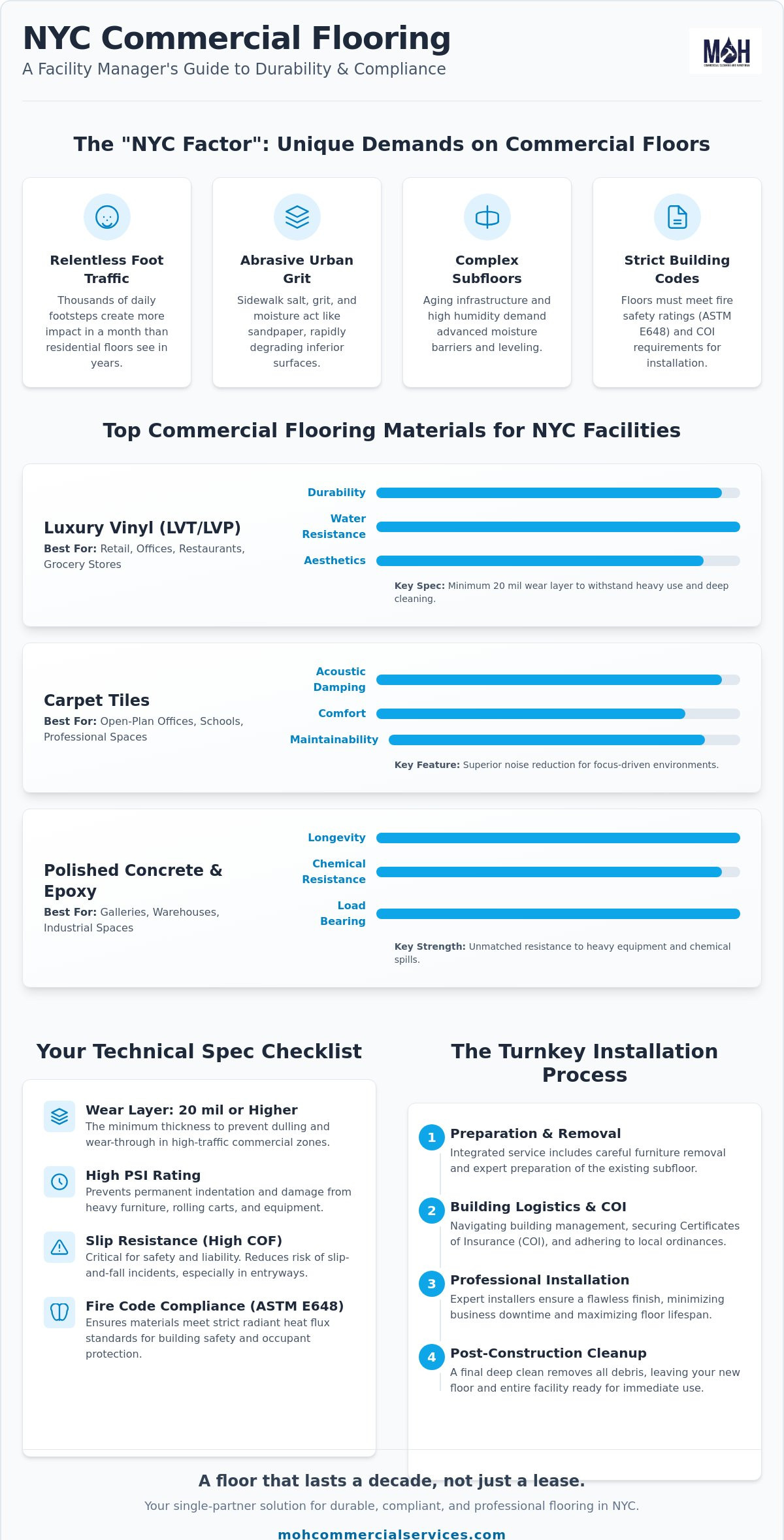
NYC foot traffic isn't just heavy; it's relentless. A standard office floor in Midtown Manhattan handles more impact in a single month than a residential floor sees in several years. When selecting flooring materials, you must prioritize technical specifications over simple visual appeal. Commercial-grade products are engineered with thick wear layers, typically 20 mil or higher, and high PSI ratings to prevent permanent indentation from heavy furniture, equipment, or constant pedestrian flow.
The "NYC Factor" involves more than just footsteps. Sidewalk salt in winter, urban grit, and constant moisture tracking create an abrasive environment that acts like sandpaper on inferior surfaces. Choosing the wrong material for your commercial flooring installation NYC project often leads to visible paths of wear and surface degradation within six months. Beyond physical wear, your facility must meet strict NYC fire codes, such as ASTM E648 for radiant heat flux, to ensure the building remains compliant and safe for occupants.
Investing in commercial-grade resilience is a strategic financial decision. Residential materials lack the structural integrity to withstand industrial cleaning chemicals and constant friction. While the initial cost of professional commercial flooring is higher, it prevents the massive secondary costs of business closure and premature replacement. A floor that fails in two years isn't a bargain; it's a liability that disrupts your operations and drains your maintenance budget.
High-Traffic Zones in New York City Businesses
Entryways, elevator banks, and service counters are the highest-impact "hot spots" in any New York building. These areas require maximum slip resistance and reinforced transition strips to handle the constant shift in weight and movement. In specialized environments like restaurant kitchens or grocery store aisles, the floor must also resist grease, acidic spills, and heavy rolling loads from delivery carts. Older NYC buildings often present unique subfloor challenges. We utilize advanced moisture barriers and leveling compounds to prevent floor bubbling and structural failure caused by the city's aging infrastructure and variable humidity levels.
Safety and Liability: Slip Resistance Standards
Safety is a legal mandate, not a suggestion. Building owners must prioritize the Coefficient of Friction (COF) to ensure surfaces remain safe even when wet. Using the correct materials reduces your liability and can lead to lower insurance premiums by decreasing the risk of slip-and-fall incidents. ADA-compliant flooring for commercial entryways must provide a firm, stable, and slip-resistant surface that remains level across all transitions to ensure accessible passage for all visitors. This standard ensures that your facility remains inclusive while protecting the business from costly legal challenges related to accessibility and premises safety.
Top Commercial Flooring Materials for NYC Facilities
Choosing the right material for your commercial flooring installation NYC project requires matching technical specs to your specific business niche. A grocery store in Queens needs a different resilience profile than a luxury boutique in SoHo. We prioritize materials that balance aesthetic appeal with the ability to withstand the abrasive grit and moisture tracking common in New York's urban environment.
Luxury Vinyl Tile (LVT) and Plank (LVP) have become the gold standard for NYC retail and office spaces. They offer the visual warmth of natural wood or stone while providing the industrial-strength durability needed for 24/7 foot traffic. For galleries and warehouses, polished concrete and epoxy coatings offer unmatched longevity and a modern, industrial look that resists heavy equipment impacts and chemical spills. If you're unsure which material fits your specific lease requirements, our team at MOH Commercial Cleaning & Handyman can help you evaluate your space's technical needs.
Luxury Vinyl Flooring: Versatility and Performance
Don't settle for less than a 20mil wear layer in a professional setting. This thickness is the minimum required to prevent the surface from dulling under heavy use. For NYC restaurants and grocery stores, waterproof LVP is a requirement to handle frequent spills and daily deep cleaning cycles. It provides a non-porous surface that won't warp or buckle when exposed to the moisture levels typically found in high-volume food service environments.
The Practicality of Carpet Tiles
Open-plan offices and schools in Manhattan often struggle with echo and ambient noise. Carpet tiles provide superior acoustic damping, making them the ideal choice for environments where focus is a priority. The primary advantage is their modular nature. You can replace a single stained or damaged tile in minutes, which is far more efficient than replacing a whole room's worth of broadloom carpet. We also recommend low-VOC options for medical offices to ensure high indoor air quality for patients and staff.
In medical facilities and commercial kitchens, hygiene is the top priority. Sheet vinyl provides a seamless, heat-welded surface that prevents bacteria from nesting in seams or cracks. This material helps facilities remain in strict alignment with the NYC Building Code regarding sanitation and safety standards. It's easy to sanitize and stands up to the harsh chemicals used in medical-grade cleaning protocols without losing its structural integrity.
Navigating NYC Installation Logistics: Building Codes and COIs
In New York, the physical act of laying a floor is often less complex than the logistical hurdles required to start the job. Building managers in Manhattan and the surrounding boroughs demand strict adherence to administrative protocols before a single tool enters the freight elevator. A valid Certificate of Insurance (COI) is the primary gatekeeper. Most commercial properties require a minimum of $1 million in general liability, though many high-rise managers now mandate limits between $2 million and $4 million, often paired with a $5 million umbrella policy. Without a compliant COI that names the building and management as additional insured, your project will stall before it begins.
Scheduling requires precision to avoid NYC noise ordinances and building-specific "blackout dates." Heavy demolition or subfloor grinding must occur during designated hours to prevent disruption to neighboring tenants. Coordinating freight elevator access is equally critical. In high-rise environments, you must book these elevators weeks in advance to ensure materials arrive on-site without incurring costly delivery delays. We manage these timelines directly with property managers to ensure your commercial flooring installation NYC project follows the specific New York flooring requirements regarding safety and construction standards.
Building Management and Board Approvals
Property managers are your most important stakeholders. We conduct comprehensive pre-installation walkthroughs to document existing conditions, protecting you from being held liable for prior building damage. It is essential to account for the latest regulatory changes. As of January 26, 2026, boards in co-op or condo-managed commercial spaces must digitally attest to renovation plans in the DOB NOW system. This requirement can add two to four weeks to your permit timeline. Our team handles the submission of work permits and ensures all debris removal follows NYC sanitation rules for construction waste. We ensure every scrap is disposed of according to city-mandated recycling and safety guidelines.
Minimizing Business Downtime
Closing your doors for a week isn't an option for most NYC businesses. We utilize phased installation strategies that allow your team to remain productive while we work on specific zones. For retail and restaurants, we offer overnight and weekend shifts to ensure the new floor is ready for customers the following morning. By using rapid-curing adhesives and high-performance underlayments, we significantly reduce the time required for the floor to reach full load-bearing capacity. This results in a seamless transition that respects your operational schedule and bottom line.
The Installation Process: Preparation and Execution
A professional floor is only as good as the surface beneath it. In the fast-paced New York market, skipping preparation steps leads to costly structural failures and safety hazards. We execute a systematic approach to ensure your investment remains stable under the heaviest traffic conditions. The actual laying of the material is the final stage of a rigorous technical process.
- Step 1: Comprehensive Subfloor Inspection: We analyze the existing slab or wood structure for cracks, moisture levels, and structural weaknesses that could compromise the new material.
- Step 2: Professional Furniture Removal: Our team handles the disassembly and temporary storage of your office furniture or restaurant equipment to clear the workspace efficiently.
- Step 3: Subfloor Leveling and Patching: We apply high-performance compounds to eliminate dips and ridges, creating a perfectly flat foundation for the new finish.
- Step 4: Precision Layout and Adhesive Application: We map the room to ensure symmetrical patterns and apply industry-specific adhesives designed for high-traffic commercial use.
- Step 5: Final Trim and Transition Strips: We install baseboards and heavy-duty transition strips to protect edges and ensure the floor remains level across different rooms.
Why Subfloor Prep is Non-Negotiable
Historic NYC buildings are notorious for uneven floors and settling foundations. You can't simply lay new material over a warped surface and expect it to last a decade. We utilize advanced self-leveling compounds for concrete or high-grade plywood underlayment for wood-framed structures to correct these deep-seated imperfections. Moisture testing is critical before laying commercial vinyl because trapped vapor can break down adhesives and cause the floor to bubble or detach from the subfloor. If you need a team that manages the entire lifecycle of your project, schedule your commercial flooring installation NYC with MOH Commercial Services today.
Post-Installation Quality Checks
Once the floor is down, the job isn't finished. We perform a rigorous inspection of all seams and perimeter bonds to confirm they meet manufacturer specifications. Respecting the initial cure time is vital for long-term durability. While light foot traffic is often possible within hours, we recommend waiting 24 to 48 hours before moving heavy desks, refrigerators, or industrial shelving back into place. We document every step of the installation, providing you with a complete record for warranty validation and insurance purposes. This methodical approach ensures your facility remains functional and professional from day one.
MOH Commercial Cleaning & Handyman: Your Turnkey NYC Flooring Partner
Most contractors exit the job site once the final plank is laid, leaving you with a layer of dust and a room full of displaced furniture. This fragmented approach forces facility managers to coordinate separate movers, handymen, and cleaning crews, which inflates costs and extends operational downtime. We eliminate this friction by providing a comprehensive, turnkey solution. When you choose MOH Commercial Cleaning & Handyman for your commercial flooring installation NYC project, you gain a partner that manages every logistical detail so your space is ready for business immediately.
Our model removes the burden of vendor management. We handle the heavy lifting, technical mounting, and final sanitation as a single, coordinated effort. This service-first strategy ensures that your facility is fully functional the moment we leave, rather than just having a finished floor in a messy room. By consolidating these tasks, we ensure that your project moves swiftly from a construction zone to a functional workspace.
- Integrated Handyman Services: We move your desks, dismount equipment, and handle furniture assembly so your team doesn't have to lift a finger.
- Deep Cleaning Expertise: Every installation includes post-construction cleanup to remove fine dust and adhesive residue, making the space "client-ready" instantly.
- Single Point of Contact: You deal with one project manager instead of juggling multiple NYC contractors.
- Maintenance Contracts: We offer ongoing janitorial support to protect your new investment and maintain its structural integrity for years.
The Advantage of an Integrated Approach
Combining flooring with our specialized handyman and painting services significantly reduces your total labor costs. It's more efficient to have one team manage the furniture layout and wall hangings while the floor is being prepped. This ensures that your office layout remains cohesive and that new wall mounts or furniture positions align with the updated floor plan. MOH Commercial Cleaning & Handyman provides a seamless transition from your old, worn-out space to a refreshed professional environment by coordinating painting and flooring as a unified project. This disciplined expertise prevents the scheduling conflicts that often delay NYC renovations.
Protecting Your Investment with Post-Install Cleaning
New floors require specific care during the first 48 hours to ensure long-term performance. Our janitorial team safely removes construction debris without scratching the new surface. For high-traffic vinyl and tile, we provide expert waxing and sealing to add an extra layer of protection against NYC sidewalk salt and urban grit. This proactive maintenance ensures the wear layer remains intact and the floor retains its professional finish. Contact MOH Commercial Cleaning & Handyman for a comprehensive facility walkthrough to see how our integrated approach can streamline your next renovation.
Protect Your Business with High-Performance Flooring
Managing a facility in New York requires more than just a new surface; it demands a logistical strategy that accounts for building codes, durability, and minimal downtime. You now have the roadmap to navigate these complexities, from selecting high-performance materials to ensuring rigorous subfloor preparation. By consolidating your project with a single partner, you avoid the common pitfalls of coordinating multiple contractors and facing unexpected delays.
MOH Commercial Cleaning & Handyman provides the specialized local knowledge needed to handle the unique pressures of the city's commercial environments. We bridge the gap between installation and operations by handling the heavy lifting, technical repairs, and deep cleaning. This ensures your investment is protected and your space is ready for clients and employees the moment the project concludes.
Don't let aging or damaged floors compromise your brand's image or employee safety. Get a Professional Commercial Flooring Quote for Your NYC Space and experience a seamless commercial flooring installation NYC that respects your time and your budget. We are ready to help you build a more resilient, professional workspace today.
Frequently Asked Questions
How long does a commercial flooring installation take in NYC?
A typical project for a 1,000-square-foot retail space usually takes between two and four business days. Larger high-rise projects require more time to account for freight elevator scheduling and material transport logistics. We provide a specific timeline after the initial site walkthrough to ensure your operational schedule remains intact.
Do I need a Certificate of Insurance (COI) for my flooring installer?
Yes, a COI is mandatory for any commercial building in Manhattan or the surrounding boroughs. Most property managers require $1 million to $2 million in general liability coverage, though some premium buildings mandate limits up to $5 million. We provide building-specific COIs that name your property management as additional insured to prevent any delays in work approval.
What is the best flooring for a high-traffic NYC restaurant?
Luxury Vinyl Tile (LVT) with a 20mil wear layer is the most reliable choice for high-traffic dining areas. For kitchens and prep zones, we recommend seamless sheet vinyl to meet NYC health codes regarding sanitation. These materials offer the necessary slip resistance and moisture protection required for high-volume food service environments.
Can commercial flooring be installed over existing tile or concrete?
Most commercial materials can be installed over existing surfaces if the subfloor is structurally sound and level. We perform a thorough inspection to determine if the current tile or concrete requires grinding or a self-leveling compound. This approach often speeds up the commercial flooring installation NYC process by eliminating the need for a full demolition.
Is commercial vinyl flooring better than carpet for a Manhattan office?
Vinyl flooring offers superior durability and ease of cleaning for high-traffic entryways and common areas. Carpet tiles are often better for open-plan offices where acoustic control and sound damping are priorities. We frequently install a combination of both materials to balance the practical need for resilience with the professional requirement for noise reduction.
How do I maintain my new commercial floors to ensure they last?
Regular maintenance involves daily sweeping to remove abrasive grit and weekly mopping with pH-neutral commercial cleaners. You should also address spills immediately to prevent staining or adhesive breakdown. We offer specialized maintenance contracts that include professional deep cleaning and sealing to extend the life of your investment for 10 years or more.
Does MOH Commercial Services handle furniture moving during installation?
Our integrated handyman team handles the full disassembly and relocation of your office furniture or restaurant equipment. We also provide professional furniture assembly once the flooring installation is complete. This turnkey approach ensures that your staff doesn't have to manage the heavy lifting or coordinate with separate moving companies during the refresh.
What happens if my building has strict noise restrictions for construction?
We coordinate with your building manager to schedule noisy tasks, such as subfloor grinding or demolition, during approved hours. If your building has a total noise blackout during the day, we offer overnight and weekend shifts to ensure the work proceeds without violating local ordinances. This flexibility keeps your project on track while respecting the neighboring tenants.