A failed health inspection is more than a regulatory setback; it's a direct compromise of patient trust and facility safety. You need an environment that meets the rigorous NYC Health Code and OSHA Bloodborne Pathogens Standard every single day. Many NYC medical administrators find that national healthcare cleaning companies lack the local accountability required for high-stakes clinical demands. It's exhausting to coordinate between a cleaning crew that misses corners and a separate handyman for minor repairs like flooring or painting.
You deserve a sterile, compliant space without the headache of managing multiple vendors or non-responsive franchises. This guide provides a clear framework for vetting healthcare cleaning companies based on clinical standards, EPA-registered disinfection protocols, and integrated maintenance solutions. You'll learn how a single point of contact for both sanitation and physical facility repairs can improve your patient satisfaction scores. We'll break down the essential criteria for choosing a partner that functions as a meticulous caretaker of your professional environment.
Key Takeaways
- Recognize the critical gap between basic janitorial work and the specialized clinical sanitation required to pass NYC health inspections.
- Understand why local healthcare cleaning companies offer greater accountability and logistical agility within the five boroughs compared to national franchises.
- Verify that your vendor maintains strict compliance with OSHA Bloodborne Pathogen standards and utilizes EPA-registered, hospital-grade disinfectants.
- Streamline operations by selecting a single partner for both medical-grade cleaning and physical facility repairs such as flooring or painting.
- Use our professional checklist to vet providers for clinical expertise and their ability to manage complex NYC building access and freight elevator rules.
Evaluating Healthcare Cleaning Companies: Clinical Standards vs. Basic Janitorial
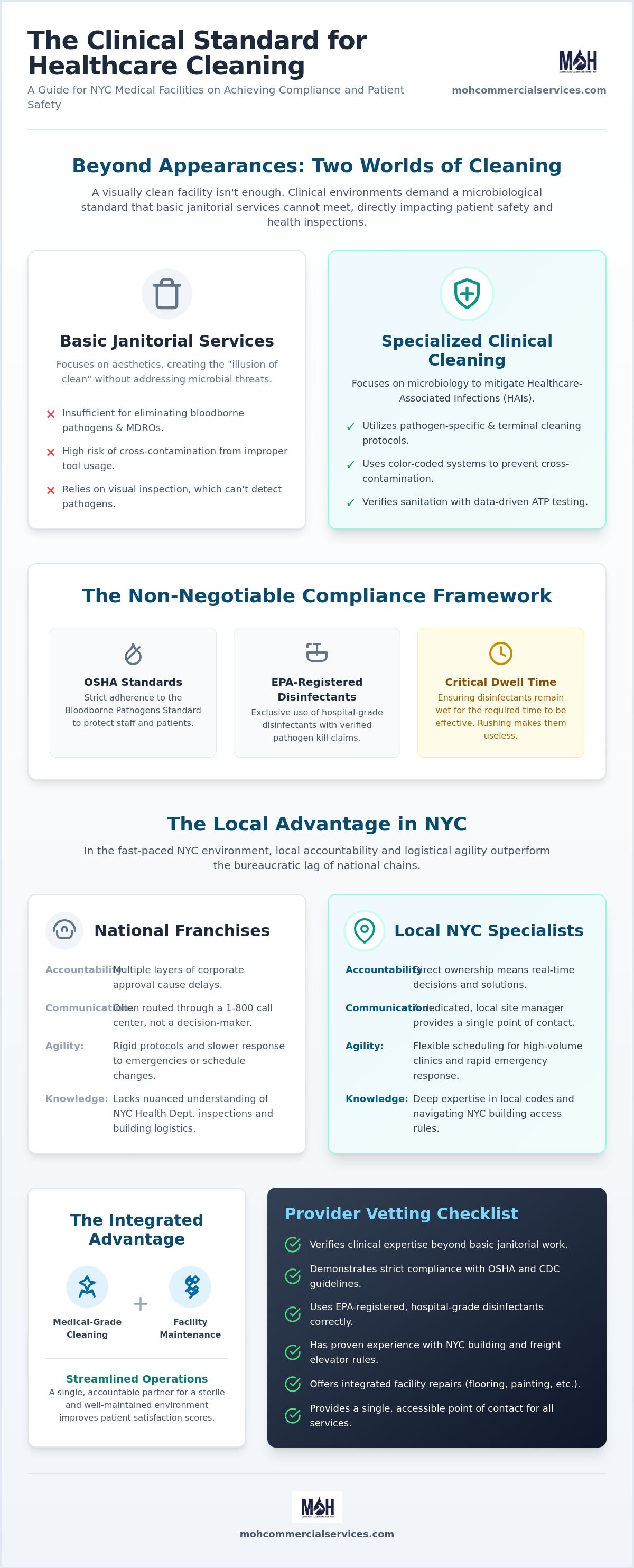
Distinction is key. Standard janitorial services focus on aesthetics, while clinical cleaning focuses on microbiology. In a medical facility, what you can't see is often more dangerous than visible debris. Specialized healthcare cleaning companies utilize pathogen-specific protocols to mitigate the risk of Healthcare-Associated Infections (HAIs). Standard office cleaning is insufficient because it lacks the technical rigor required to eliminate bloodborne pathogens or multi-drug resistant organisms. High-touch surfaces in waiting areas and exam rooms, such as door handles, armrests, and tabletops, require frequent disinfection with agents specifically rated for clinical use. Terminal cleaning protocols are a comprehensive, multi-step decontamination process that removes all organic matter and utilizes hospital-grade disinfectants to render a clinical space safe for the next patient encounter.
The Illusion of Clean: Why Visual Inspection Isn’t Enough
A shiny floor doesn't guarantee a sterile environment. Professional teams use ATP (Adenosine Triphosphate) testing to verify sanitation levels by measuring organic matter left on surfaces. Without this data, cleaning is just guesswork. Cross-contamination is another significant risk. Using the same cloth for a waiting room chair and an exam table spreads bacteria. To prevent this, technicians use color-coded microfiber systems. Red might be for high-risk biohazard areas, while blue is reserved for general surfaces. This ensures that germs stay contained and are properly neutralized. It's a disciplined approach that separates experts from generalists.
Hospital-Grade Disinfectants and EPA Registration
Chemical selection is a technical decision. Every product used must be an EPA-registered, hospital-grade disinfectant. This registration means the EPA has verified the product's efficacy against specific pathogens when used according to the label. One common error made by general healthcare cleaning companies is ignoring dwell time. Dwell time is the duration a disinfectant must remain wet on a surface to kill the target organism. Rushing this process renders the chemical useless. Modern facilities now demand a balance; sustainable green cleaning agents that offer the same clinical-grade kill claims without the harsh fumes or residue of traditional bleach-based products are now the standard for patient safety and comfort.
National Franchises vs. Local NYC Healthcare Cleaning Specialists
National healthcare cleaning companies often market themselves on scale, but scale frequently breeds bureaucratic lag. When a clinic manager in Brooklyn needs an immediate adjustment to a protocol, a national franchise often requires multiple levels of corporate approval. Local NYC specialists operate with a different level of agility. Direct ownership means decisions happen in real time. This accountability is vital when navigating the specific logistical hurdles of the five boroughs. A local partner understands that a 15-minute delay at a Midtown service entrance can derail an entire sanitation window. They also possess firsthand knowledge of NYC Health Department inspection patterns, ensuring your facility remains prepared for local scrutiny. Adhering to CDC cleaning and disinfection guidelines is the baseline; knowing how NYC inspectors apply those rules is the local advantage.
Accountability and Direct Communication
The 1-800 number experience is the hallmark of national brands. If a spill occurs or a room is missed, you're often routed to a call center instead of a decision-maker. Local providers offer a dedicated site manager who is physically present in the city. Consistent cleaning crews become familiar with your facility’s specific layout and security protocols, which significantly reduces the risk of errors. For Manhattan-based clinics, having a team nearby is the only way to guarantee a rapid response to emergency spills or biohazard incidents.
Customizing Schedules for High-Volume NYC Clinics
High-traffic urgent care centers in boroughs like Queens or the Bronx don't follow a standard 9-to-5 schedule. They require flexible sanitation windows that don't disrupt patient flow. Local healthcare cleaning companies can pivot schedules to accommodate fluctuating patient volumes or emergency maintenance needs. In shared medical buildings, professional appearance is mandatory. Technicians must be discreet and efficient to maintain the professional atmosphere your patients expect. If you're looking for a partner that understands these local demands, explore how specialized medical office cleaning can streamline your operations.
Compliance and Safety Protocols: OSHA, CDC, and Beyond
Compliance in a clinical setting is a matter of legal survival and patient safety. NYC medical facilities must adhere to a complex web of federal and local mandates, including the NYC Health Code (24 RCNY) and New York State Public Health Law Article 28. Reliable healthcare cleaning companies don't just "clean"; they execute a documented safety program. This includes strict adherence to OSHA's Bloodborne Pathogens Standard, which requires every technician to undergo annual training on exposure control and the proper use of Personal Protective Equipment (PPE). Without these verified protocols, your facility faces significant liability risks and potential inspection failures.
Security is another pillar of professional compliance. Because cleaning crews often operate after hours, they must be trained in HIPAA-awareness to ensure Protected Health Information (PHI) remains secure. Whether it's securing patient files left on desks or ensuring digital screens are shielded, a specialized partner understands the privacy stakes. For providers seeking this level of disciplined expertise, MOH Commercial Cleaning & Handyman integrates these security measures into every shift. Our approach to Medical Office Cleaning NYC prevents the common pitfalls associated with general janitorial crews who lack healthcare-specific training.
Infection Prevention and Control (IPC) Strategies
Air quality is as critical as surface sanitation. We utilize high-efficiency particulate air (HEPA) filtration systems to capture microscopic pathogens and allergens that standard vacuums simply redistribute. Our "Pathogen-Specific" approach utilizes the EPA’s List N disinfectants to target specific threats like COVID-19, MRSA, and the seasonal flu. Documentation is the final step in IPC. We maintain timestamped logs and service reports that provide a clear audit trail for Department of Health surveyors, proving that your facility meets the twice-daily disinfection requirements for high-risk areas.
Safety Data Sheets (SDS) and Chemical Management
Chemical safety requires meticulous organization. Every healthcare cleaning companies partner must maintain an accessible binder of Safety Data Sheets (SDS) for every agent used on-site. This is a non-negotiable OSHA requirement. Proper storage is equally vital; chemicals must be secured in designated areas to prevent accidental exposure to patients or staff. Our technicians are also trained in the safe handling of areas surrounding biohazardous waste. While we don't dispose of red-bag waste, we ensure the surrounding environment is decontaminated without compromising the integrity of sharps containers or biohazard bins.
The Integrated Advantage: Cleaning Meets Facility Maintenance
A sterile environment requires more than surface-level sanitation; it demands structural integrity. Most healthcare cleaning companies focus exclusively on the mop and bucket, but a "Whole-Facility Partner" understands that sanitation and maintenance are inseparable. Minor physical defects, such as cracked floor tiles or peeling wall paint, act as microbial reservoirs where bacteria can thrive despite regular disinfection. By addressing these defects immediately, you eliminate the hiding spots for pathogens that compromise your clinical standards. Maintaining a truly compliant space means ensuring every square inch of the facility is both clean and structurally sound.
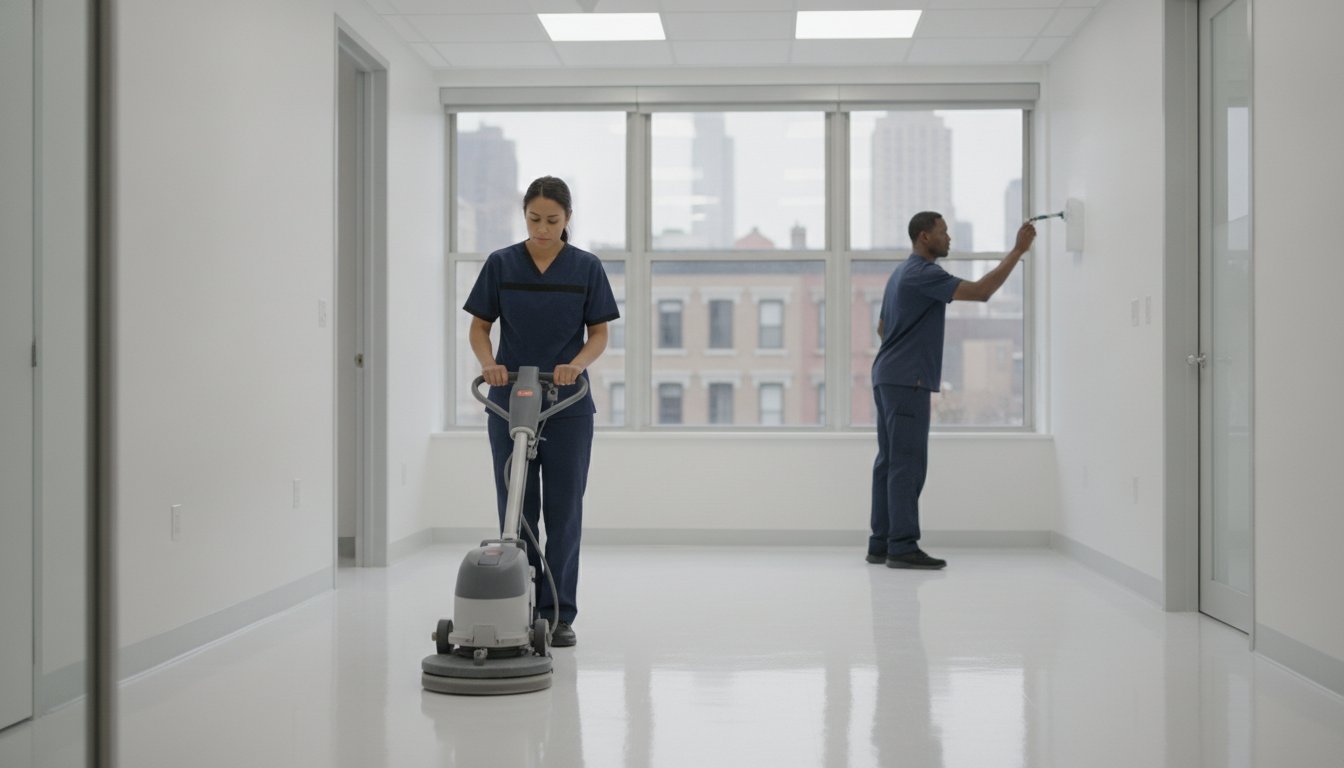
Efficiency is the primary driver for integrating these services. Coordinating between a cleaning crew and a separate handyman leads to scheduling conflicts and an increased administrative burden. Using a single partner for both terminal cleaning and furniture assembly ensures your facility remains operational without unnecessary downtime. Whether you're opening a new clinic or expanding an existing one, having a team that can assemble exam tables and then immediately perform a clinical deep clean streamlines the entire process. This dual capability ensures that your professional environment is ready for patients without the friction of managing multiple vendors.
Handyman Services for Medical Office Optimization
Professional medical office optimization often involves technical installations that general cleaners can't handle. Waiting rooms require secure TV mounting for patient education and entertainment. As you expand, professional furniture assembly ensures that new workstations and exam room equipment are stable and safe. Even the placement of medical certifications and art matters; precise wall hanging services project an image of disciplined expertise and improve patient trust in your facility's professionalism. These tasks are essential for a functional, welcoming clinical space.
Maintaining Structural Integrity for Sanitation
Structural integrity is the foundation of a truly sterile environment. Professional painting provides a cleanable barrier on walls, while high-quality flooring prevents the accumulation of grime in seams or cracks. Commercial vinyl flooring is particularly effective in high-traffic NYC clinics because of its durability and ease of sanitation. To understand how the right materials impact your facility's longevity, review our guide on Commercial Flooring Installation NYC. Maintaining these surfaces isn't just about aesthetics; it's a proactive strategy to prevent slips, falls, and bacterial growth. If you're ready to simplify your facility management, request a comprehensive maintenance and cleaning quote to see the difference an integrated approach makes.
Choosing Your Healthcare Cleaning Partner in NYC
Selecting the right partner among healthcare cleaning companies in NYC requires a focus on three non-negotiable pillars: clinical expertise, local accountability, and service versatility. A partner who understands the difference between visual cleanliness and microbial sanitation is essential for patient safety. However, expertise alone isn't enough in the five boroughs. You need a team that answers the phone immediately and understands the logistics of freight elevators and Midtown service entrances. Finally, versatility ensures that your facility remains functional, not just clean. By choosing a provider that manages both medical-grade sanitation and physical repairs, you eliminate the friction of coordinating multiple vendors and reduce administrative overhead.
The Vetting Checklist for Medical Facility Managers
A professional service proposal should be transparent and line-itemed. Avoid generic quotes that don't account for your facility's specific layout or patient volume. A physical walk-through is mandatory for an accurate assessment of high-touch zones and floor maintenance needs. Use the following checklist to vet potential healthcare cleaning companies during the interview process:
- Can you provide proof of $2 million in general liability insurance and full workers' compensation coverage?
- Are your technicians W-2 employees who have completed annual Bloodborne Pathogen (BBP) training?
- Do you have documented experience navigating NYC-specific building access rules and waste disposal regulations?
- Can you provide three references from local medical offices or ambulatory surgery centers?
- Does your service include a single point of contact for both cleaning and facility maintenance tasks like painting or flooring?
Next Steps: Securing Your Clinical Environment
Compliance lapses and hygiene failures aren't just administrative errors; they're direct risks to patient safety and facility licensure. Waiting to replace an unresponsive or inconsistent cleaning crew only increases the likelihood of a failed health department inspection. MOH Commercial Cleaning & Handyman bridges the gap between specialized sanitation and technical facility maintenance. We offer a results-driven partnership built on professional urgency and steadfast reliability. Our team handles everything from terminal cleaning to TV mounting and furniture assembly, ensuring your space remains fully functional and compliant. Transitioning to a comprehensive provider is a seamless process designed to protect your facility's reputation. Request a comprehensive medical facility maintenance quote to begin securing your clinical environment today.
Secure Your Facility’s Compliance and Operational Readiness
Managing a medical office in New York City requires more than a standard sweep and mop. You need a partner that distinguishes between visual cleanliness and true clinical sanitation. The most effective healthcare cleaning companies provide a seamless blend of specialized pathogen protocols and local accountability. By integrating janitorial expertise with commercial handyman services like furniture assembly and flooring repair, you eliminate the logistical friction of managing multiple vendors. This unified approach ensures your space meets the NYC Health Code while remaining physically optimized for patient care. It's about creating an environment where patients feel safe and staff can operate without facility-related distractions.
Take the first step toward a more efficient, sterile, and professional environment. Partner with MOH Commercial Cleaning & Handyman for Clinical-Grade Facility Maintenance to leverage our specialized medical office sanitation and comprehensive handyman versatility. Our local NYC team is ready to provide the professional urgency and steadfast reliability your clinic demands. Your facility deserves a dedicated caretaker who values operational excellence as much as you do.
Frequently Asked Questions
What makes healthcare cleaning different from standard commercial janitorial services?
Healthcare cleaning prioritizes the elimination of pathogens and bacteria through technical disinfection rather than just surface-level dust removal. It involves using EPA-registered chemicals and specific dwell times to neutralize microscopic threats in exam rooms and surgical suites. Standard janitorial services focus primarily on the visual appearance of a space, which is insufficient for clinical environments where cross-contamination risks are high.
How do healthcare cleaning companies ensure compliance with OSHA and CDC guidelines?
Top-tier healthcare cleaning companies maintain compliance through rigorous employee training and detailed service logs. They implement OSHA's Bloodborne Pathogens Standard, ensuring all staff use correct PPE and follow exposure control plans. By strictly following CDC guidelines for environmental infection control, these companies provide a documented audit trail that is essential for passing New York State Department of Health surveys and local NYC inspections.
Can a healthcare cleaning company also handle minor repairs and handyman tasks?
Yes, certain specialized providers function as a single point of contact for both sanitation and physical facility maintenance. This integrated approach allows a facility manager to coordinate cleaning alongside tasks like TV mounting, furniture assembly, and flooring repairs. Consolidating these services prevents the logistical nightmare of managing multiple vendors and ensures that physical defects harboring bacteria are repaired promptly.
How often should a medical office undergo deep or terminal cleaning?
High-risk clinical areas require terminal cleaning after every patient encounter involving infectious materials or surgery. For general medical offices, the NYC Health Code mandates that high-touch surfaces be disinfected at least twice daily. Deep cleaning schedules are typically determined by patient volume and the specific medical specialty, but most facilities benefit from a comprehensive deep clean at least once a month.
What certifications should I look for in a healthcare cleaning provider?
Look for providers who can verify annual OSHA Bloodborne Pathogen training and HIPAA-awareness certification for all staff. While general commercial licenses are standard, specialized medical office cleaners often hold certifications from organizations like the Association for the Health Care Environment (AHE). It's also vital to confirm they carry at least $2 million in general liability insurance to protect your facility from operational risks.
How does professional cleaning impact patient satisfaction scores (HCAHPS)?
Professional cleaning directly influences patient perception and HCAHPS scores. Patients frequently equate the visual cleanliness of a waiting room or exam area with the clinical competence of their healthcare provider. A sterile, well-maintained environment reduces patient anxiety and leads to higher ratings regarding the safety and quality of the facility.
Are green cleaning products effective enough for a clinical environment?
Green cleaning agents are effective in clinical settings only when they are EPA-registered as hospital-grade disinfectants. Many modern sustainable products appear on the EPA's List N, meaning they are verified to kill emerging viral pathogens. These products provide the necessary kill claims without the harsh odors or respiratory irritants associated with traditional bleach, improving the environment for both patients and staff.
What is the standard response time for emergency disinfection services in NYC?
Standard response times for emergency disinfection in NYC typically range from two to four hours for local providers. National franchises often struggle with this speed due to bureaucratic dispatching processes. A local NYC team understands the urgency of a biohazard spill or an infectious disease outbreak and can navigate city traffic and building access rules to provide immediate remediation.